China’s GJ-11 Combat Drone Flies With J-20, Hints at Manned-Unmanned Ops

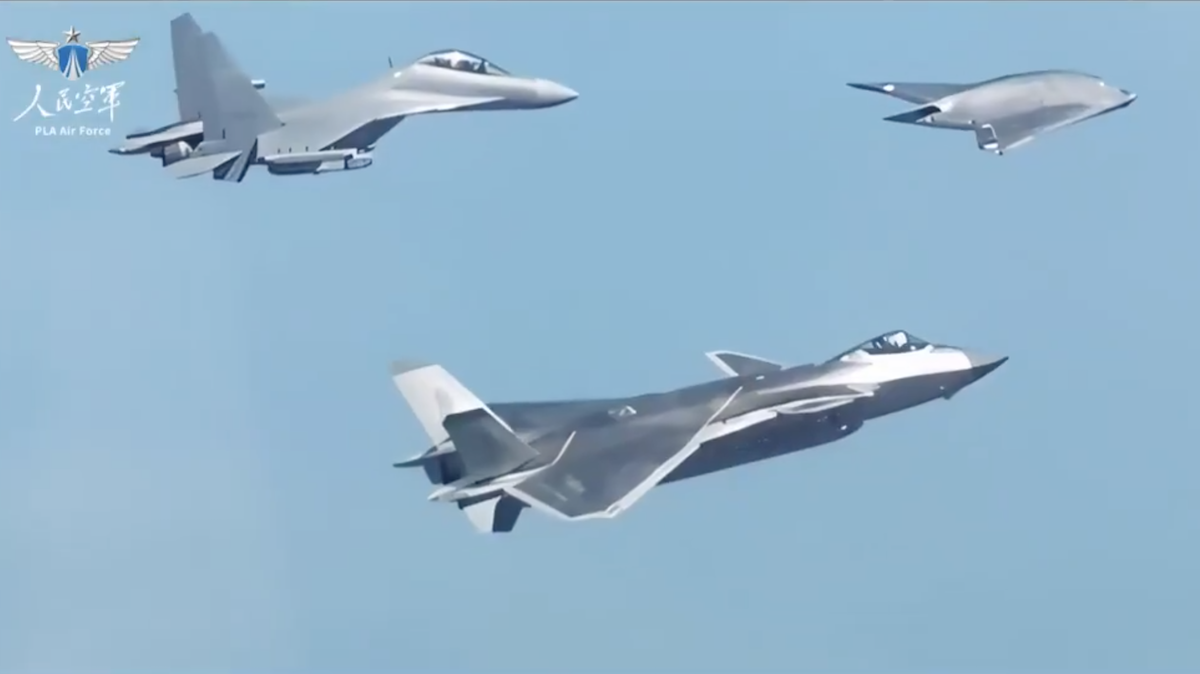
China has released the first official footage of its stealthy GJ-11 combat drone flying in formation with a piloted J-20 fighter jet and a J-16D electronic warfare aircraft.
The footage, part of a video commemorating the 76th anniversary of the People’s Liberation Army Air Force (PLAAF), marks what appears to be the most public sign yet that the flying-wing drone is nearing, or has reached, operational status.
While Beijing has not officially confirmed the GJ-11’s operational deployment, the PLAAF video and the presence of three GJ-11s at Tibet’s Shigatse Air Base, as reported by The War Zone last month using satellite imagery, further indicate that the aircraft is at least in advanced testing, if not in limited service.
First flown in 2013 and later refined into a more stealth-optimized version, the drone was publicly unveiled during China’s 2019 National Day Parade.
It returned to public view at the September 2025 Victory Day military parade with visible folding-wing hinges, suggesting a potential carrier-based variant.
Manned-Unmanned Teaming
The GJ-11 reportedly features a radar-absorbent material in its flying-wing design, along with internal weapons bays and a shrouded exhaust for reduced infrared visibility.
Analysts believe the drone is intended for strikes, as well as intelligence, surveillance, and reconnaissance missions in contested airspace, with the endurance to accompany or support crewed stealth fighters.
In the PLAAF anniversary footage, the GJ-11 appears to operate autonomously or semi-autonomously as it flies in formation with the J-20 and J-16, rather than performing complex manned-unmanned teaming maneuvers.
It also implied that the drone, formerly known as “Sharp Sword,” has a new name: “Xuanlong,” which means “Mysterious Dragon.”
In the video’s audio, a ground or airborne controller informs the Weilong 01 (referring to the J-20 Mighty Dragon) that Xuanlong 08 has reached its position, to which the pilot replies to confirm coordination and establish a link between the two aircraft.
The footage suggests growing maturity in flight control and air-integration systems as Beijing develops autonomous combat aircraft designed to operate alongside crewed fighters.
The effort parallels the US Air Force’s Collaborative Combat Aircraft (CCA) program, which seeks to field “loyal wingman” drones — such as General Atomics’ YFQ-42 and Anduril’s YFQ-44 — capable of flying alongside or ahead of piloted fighters like the F-35 and Next Generation Air Dominance platforms.