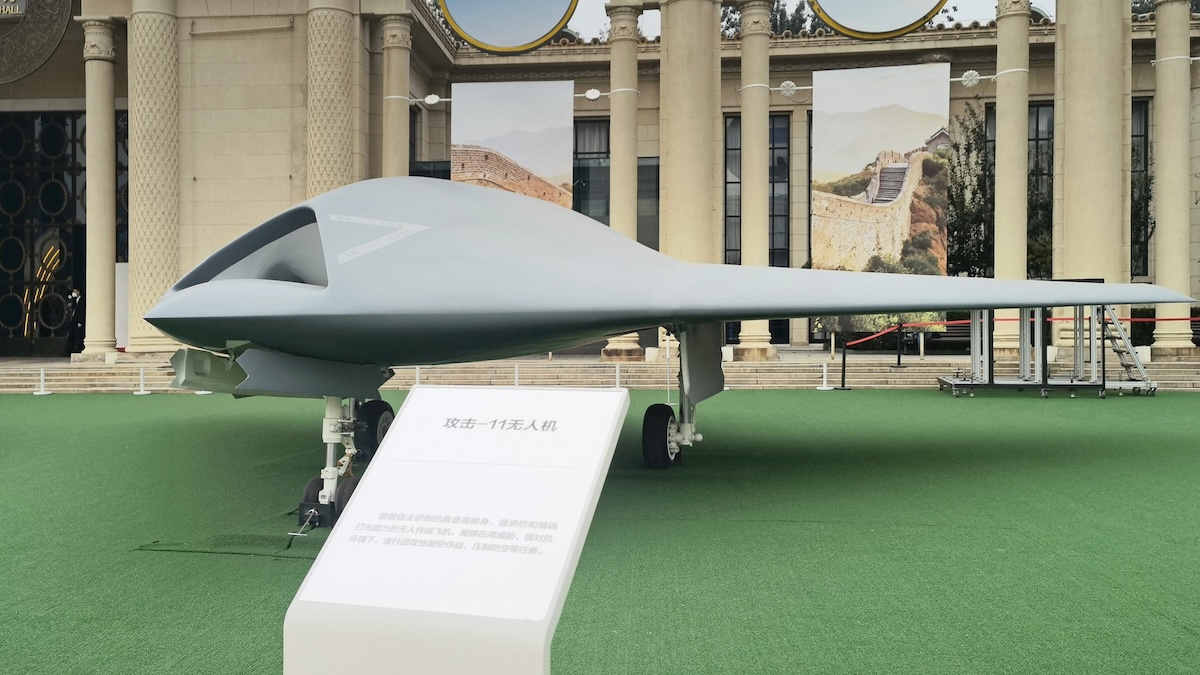
China’s GJ-11 ‘Sharp Sword’ Emerges as Potential Carrier-Based Combat Drone

China’s GJ-11 “Sharp Sword” is emerging as a potential carrier-based uncrewed combat aerial vehicle (UCAV), which could make it the People’s Liberation Army’s first shipborne stealth drone.
First unveiled during the country’s 2019 National Day parade, the aircraft returned to public view at the 2025 Victory Day military parade with visible folding wing hinges — a design feature typically associated with carrier operations.
These updates suggest a possible deployment aboard platforms such as the Chinese Navy’s first Type 076 amphibious assault ship, whose emblem features imagery resembling the drone’s wing profile, according to the South China Morning Post.
Previous reports and mockups have also hinted at ongoing development and testing of carrier-capable variants of the GJ-11, though its operational status and full capabilities remain unconfirmed.
Built for Stealth, Strike, and Support
The GJ-11 traces its roots to the “Sharp Sword” project, launched in 2009 by Shenyang Aircraft Corporation. It is now produced by the Hongdu Aviation Industry Group, which is a subsidiary of China’s state-owned Aviation Industry Corporation of China.
Designed primarily for strike missions, it is also capable of multiple roles, including air suppression, intelligence, surveillance, and reconnaissance (ISR), as well as loyal wingman tasks supporting crewed fighters like the J-20.
It is reportedly capable of autonomous operations with artificial intelligence support for complex missions.
Built for reduced radar detection, the tailless aircraft comes with a flying wing design and a fully blended body, as well as a low radar cross-section and segmented control surfaces built into the trailing edge for flight stability.
In addition, it features an S-shaped air intake, a shielded, flattened exhaust nozzle, and light gray paint similar to China’s crewed stealth fighters to maximize stealth.
The airframe measures 10 meters (33 feet) in length with a 14-meter (46-foot) wingspan and an estimated takeoff weight of 10 tonnes (22,000 pounds). It is capable of carrying various types of ammunition, including cruise missiles, anti-radiation missiles, and precision-guided bombs.
It is estimated to fly at subsonic speeds, remain airborne for approximately six hours, and reach a combat radius of more than 1,500 kilometers (930 miles), covering key areas in the East and South China Seas from the Chinese coast, or extending far beyond when deployed from carriers.