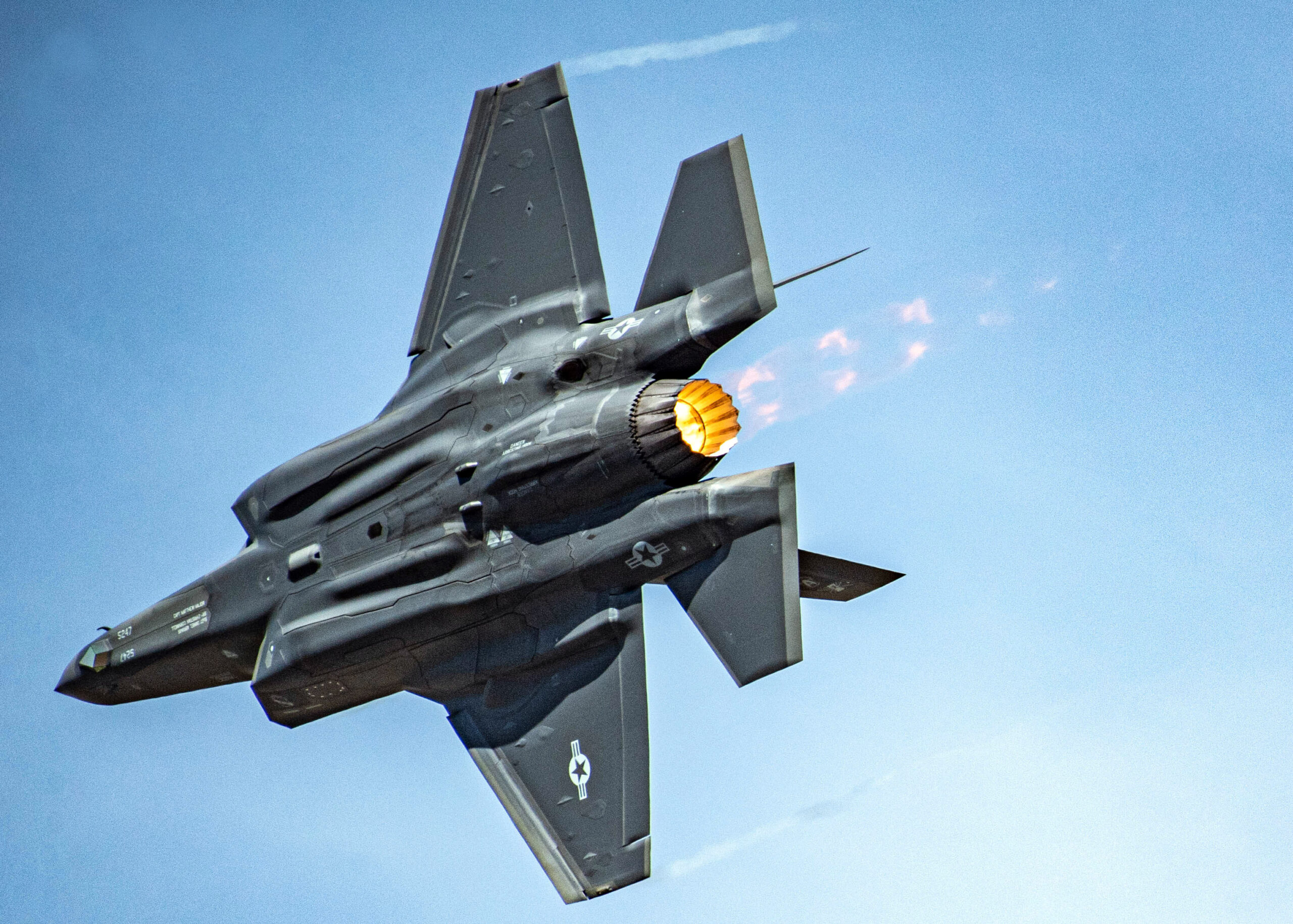
RTX subsidiary Pratt & Whitney has signed a contract worth up to $2.8 billion to build engines for the F-35 Joint Strike Fighter.
The agreement includes the production of 141 F135 propulsion systems, which will be distributed across the US Air Force, US Navy, US Marine Corps, international program partners, and foreign military sales buyers.
Work will take place across multiple US sites, with the majority across Connecticut, Indiana, and Washington.
Additional production will occur in Maine, California, Michigan, Oregon, Indiana, Georgia, Virginia, New Jersey, and other US locations, as well as overseas facilities.
The East Hartford-based company is scheduled to complete the initiative by February 2028, with progress to be coordinated with the Naval Air Systems Command in Maryland.
For Lot 18 Fleet
The US Department of Defense stated that the latest F135 engine package supports the full-rate production of Lot 18 for the Joint Strike Fighter program, which encompasses 145 F-35 jets under an $11.8-billion contract awarded in December 2024.
As part of this effort, the US Air Force will receive 48 F-35As, while the US Marine Corps will add 16 F-35Bs and five F-35Cs. The US Navy is also slated to acquire 14 F-35Cs.
International deliveries include 39 F-35As and seven F-35Bs for foreign military sales customers, while undisclosed non-program partners will receive 15 F-35As and one F-35B.
Most of the production work will be carried out at Lockheed Martin’s facilities in Texas and California, with completion expected by June 2027.
The F135 Engine
Pratt & Whitney’s F135 system is an afterburning turbofan engine derived from the F119 used in the F-22 Raptor, America’s first fifth-generation combat aircraft introduced in the 1990s.
The engine measures 220 inches (559 centimeters) in length, 46 inches (117 centimeters) in diameter, and weighs up to 1,770 kilograms, depending on the variant.
In an F-35, the F135 generates 115,000 horsepower, enabling operations at altitudes up to 50,000 feet (15,240 meters), a range of more than 1,300 nautical miles (1,496 miles/2,408 kilometers), and a top speed of Mach 1.6 (about 1,228 miles/1,976 kilometers per hour).