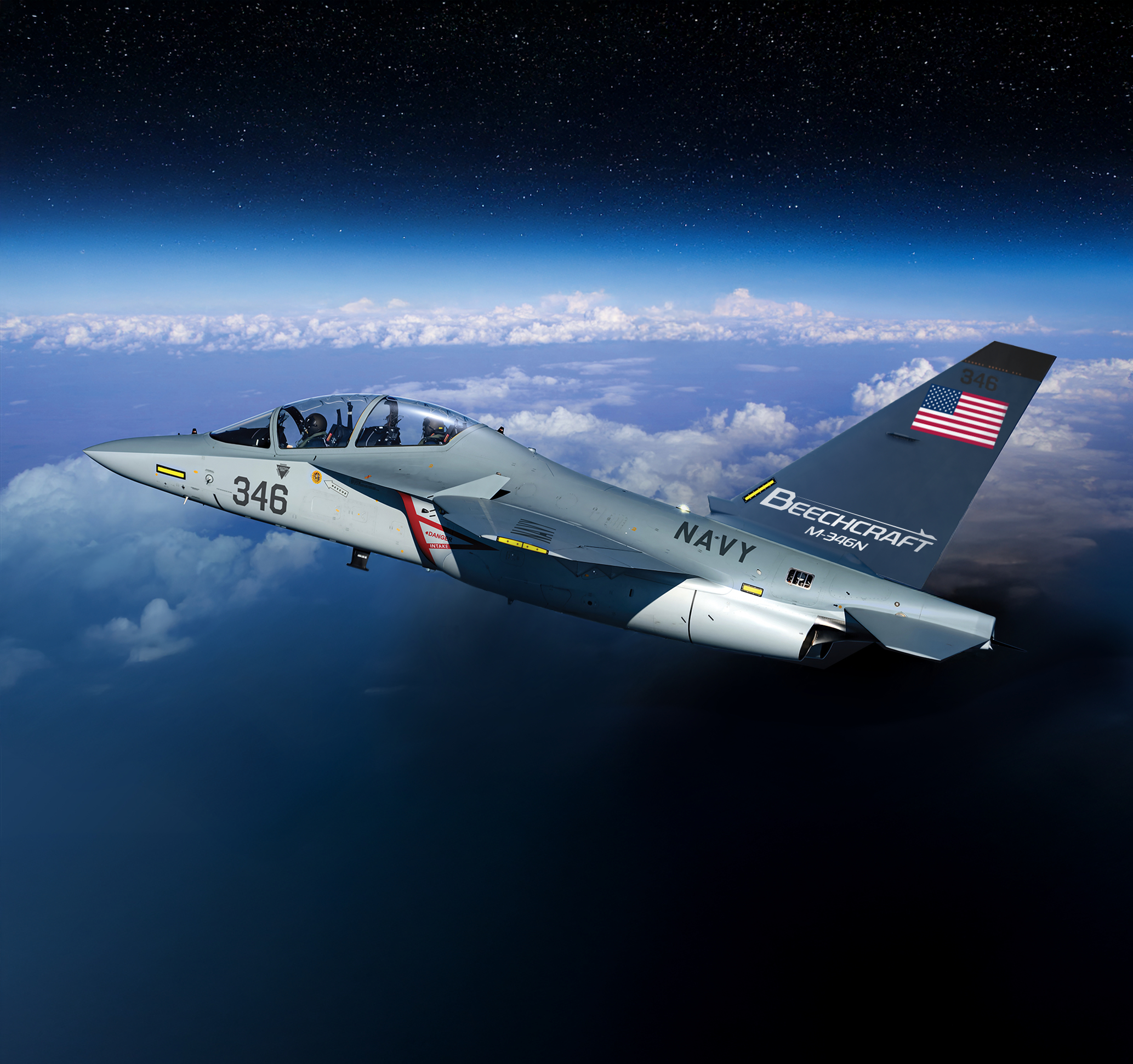
Textron and Leonardo have teamed up to offer the Beechcraft M-346N light aircraft for the US Navy’s Undergraduate Jet Training System program.
The collaboration aims to respond to an upcoming Department of Defense solicitation for a modern platform to replace the T-45 Goshawk, which is currently used to certify naval airmen to operate advanced carrier-capable aircraft.
The M-346N is based on Leonardo’s original M-346 airframe, introduced in 2004, which has been used internationally to train pilots for fourth- and fifth-generation fighter aircraft, including at Italy’s International Flight Training School.
“With our heritage deeply rooted in the strength and reliability of American manufacturing, the Beechcraft M-346N joins a proud lineup of aircraft built on 95 years of aviation excellence,” Textron Aviation Defense CEO and President Travis Tyler commented.
“The aircraft can be the cornerstone for the Navy’s future of undergraduate jet training, combining operationally-proven performance with cutting-edge technologies.”
The Beechcraft M-346N
The M-346N features a two-seat configuration, digital flight controls with quadruple redundancy, a modern cockpit design, an automatic ground collision avoidance system, and a pilot-activated recovery system.
It incorporates an Embedded Tactical Training System that enables in-flight simulation of sensors, weapons, and computer-generated forces to provide realistic mission training.
The platform is also supported by an Integrated Ground-Based Training System, which includes simulators, mission planning stations, digital classrooms, and logistics support to enhance cadet training.
In addition, the M-346N offers Live-Virtual-Constructive capability, combining live flights with virtual elements and synthetic threats to deliver a fully immersive training experience.
The aircraft measures 11 meters (36 feet) in length, has a wingspan of 10 meters (33 feet), and is powered by twin Honeywell F124 engines.
It can reach speeds of up to 590 knots (1,093 kilometers/679 miles per hour), has a range of approximately 1,300 nautical miles (2,407 kilometers/1,496 miles), and a service ceiling of 13,715 meters (44,997 feet).