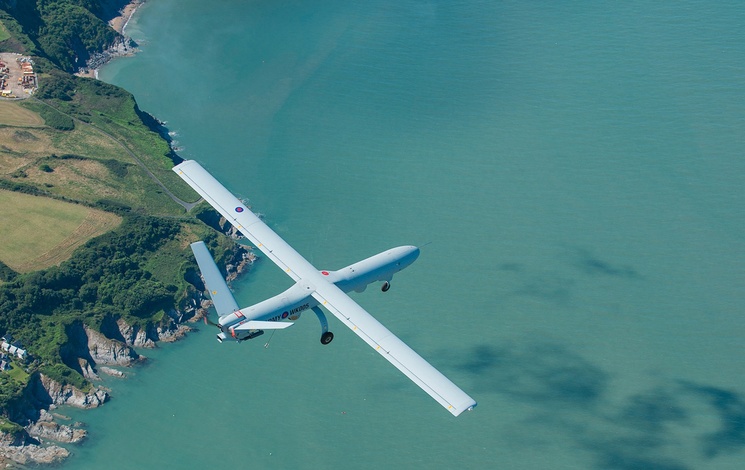
In the ever-evolving arena of modern warfare, not all battles are fought with bullets. Some are waged through pixels, sensors, and silent wings circling thousands of feet above the battlefield.
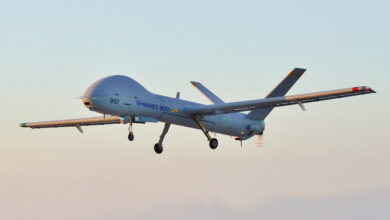
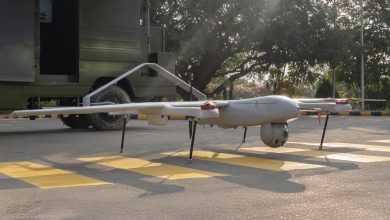
Meet the Watchkeeper WK450, the British Army’s eye in the sky for over a decade. Born from Israeli drone expertise and British defense ambition, this unarmed but powerful surveillance platform has flown quiet, crucial missions from the deserts of Afghanistan to the shores of the English Channel.
At first glance, the WK450 might seem modest compared to the sleek, weapon-laden drones in American arsenals. But under its 10.5-meter (34.4-feet) wingspan lies a surprisingly capable intelligence-gathering system: dual electro-optical and infrared sensors, all-weather radar, and the ability to beam back real-time imagery to commanders on the ground.
Designed to loiter for 16 hours and optimized for battlefield reconnaissance, the Watchkeeper has served as the UK’s primary tactical unmanned aerial vehicle (UAV), though not without setbacks, delays, and an early retirement now set for 2025.
This guide explores the full story: how Watchkeeper was developed, what makes it unique, where it succeeded, where it struggled, and what comes next.
The Watchkeeper WK450 is a British Army tactical ISTAR (intelligence, surveillance, target acquisition, and reconnaissance) UAV co-developed by Thales UK and Elbit Systems. It is derived from the Israeli Elbit Hermes 450 but adds an integrated dual-sensor payload and all-weather autonomy.
The WK450 can carry up to 150 kilograms (330 pounds) of sensors and datalinks. It communicates via a NATO-standard line-of-sight datalink (150 kilometers/93 miles) with optional satellite link for beyond-line-of-sight extensions. Key specifications are tabulated below:
Parameters and Specifications
| Wingspan | 10.5 meter (34.4 feet) |
| Length | 6.5 meter (21.3 feet) |
| Endurance | >16 hours |
| Range (line-of-sight) | >150 kilometers (93 miles) |
| Payload capacity | 150 kilograms (331 pounds) |
| Powerplant | 1× UAV Engines Wankel rotary engine (38.8 kW) |
| Sensors | Dual electro-optical/IR cameras + Thales I-MASTER SAR/GMTI radar + laser designator |
| Datalink | Radio LOS (150 kilometers/93 miles) plus optional satellite link |
| Ground Control | Mobile 20′ containerized Ground Control Station |
| Launch/Recovery | Conventional runway takeoff; automated takeoff & landing (Magic ATOLS) |
The Watchkeeper’s sensor suite combines day/night EO/IR cameras with a dual-mode SAR/GMTI radar, enabling all-weather surveillance. It also carries a laser rangefinder/designator to support precision targeting.
The system uses a single lightweight Wankel piston engine for propulsion.
Flight trials have demonstrated automatic takeoff and landing under adverse conditions (the ATOLS system). Ground crews operate the UAV from a mobile mission shelter (ground control station), which interfaces via datalink to provide near-real-time imagery and target data to commanders.
Development History
Thales UK and Elbit Systems formed a joint venture (U-TacS) to fulfill the UK’s tactical UAV requirement in the mid-2000s.
In July 2004, Thales UK was named preferred bidder, and in August 2005 the Ministry of Defence awarded a 775-million pound contract for “design, manufacture and initial support” of 54 Watchkeeper WK450 air vehicles.
U-TacS (51 percent Elbit UK, 49 percent Thales UK) set up manufacturing in the UK. The first prototype WK450 flew on April 16, 2008 in Israel. By late 2008 the automated takeoff/landing system (Magic ATOLS) had been successfully tested. A UK support contract was signed in 2010, and early systems were delivered thereafter.
Watchkeeper proved slower to mature than planned. It was originally meant to enter service around 2010, but technical issues delayed full operation until later.
The first Watchkeepers arrived in Afghanistan in 2014 (supporting UK troops at Camp Bastion).
Initial operational capability was achieved that year, but full operational capability slipped to 2019.
The program’s costs overran: early reports noted an initial budget of 800 million pounds, but by 2012 spending already exceeded 847 million pounds. By 2022, the UK had spent about 1.31 billion pounds on Watchkeeper.
The program has become symbolic of UAV procurement challenges (delays, cost growth), and in late 2024 the UK announced Watchkeeper will retire by March 2025 — much earlier than its original 2042 out-of-service date.
Operational Use
In British Army service, Watchkeeper has been used primarily for battlefield surveillance.
One battery (four aircraft) deployed to Helmand Province, Afghanistan in August 2014. It flew over 140 hours (about 8 hours a day) through October that year, providing wide-area reconnaissance to support coalition forces withdrawing from Camp Bastion. Notably, the WK450 fed its radar tracks to allied UAVs (Hermes 450 and MQ-9 Reaper) to cue targeting.
Outside Afghanistan, Watchkeeper has rarely been used in combat: it was not employed in the UK’s operations in Libya or Iraq, unlike off-the-shelf drones.
Domestically, Watchkeeper saw use in homeland security.
In 2020-2021 under Operation Devran, UK Border Force borrowed Army Watchkeepers to patrol the English Channel for migrant boats. The UK Border Force logged only 15 sorties (44 flight hours) in Sept 2020 and 6 sorties (24 hours) in October 2020. The operation was criticized as having limited practical effect on preventing crossings.
Most recently, Watchkeeper has been deployed on NATO exercises. In October 2024, the British Army flew upgraded Watchkeeper sensors on exercises in Estonia (Exercise Athena Shield), demonstrating enhanced ISTAR capability with allies. This involved newer electro-optical payloads and datalink work alongside Estonian forces.
Notably, Watchkeeper has also been used for training and trials in the UK; for example, flight training has been relocated to warmer climates to avoid UK weather issues.
Operators and Deployment History
United Kingdom: The sole military operator of the WK450 has been the British Army. All UK Watchkeepers are assigned to 47 Regiment Royal Artillery (Unmanned Aerial Systems), which trains crews and conducts UAV missions. The Army used Watchkeeper in Afghanistan (2014) and for domestic surveillance as above; it also loaned aircraft to the UK Border Force for Channel patrols. The fleet was stationed at the Army’s UAV base (Army Flying Centre) in Wiltshire for training and maintenance.
Other Users: No other nation operates the standard WK450 as of 2024. However, an export variant has emerged. In December 2022, Romania signed a deal to acquire up to seven Watchkeeper X systems (the export version).
The five-year framework is worth roughly 1.89 billion Romanian lei ($409 million). The first three WKX systems (initial purchase order) were delivered by Elbit in 2023 for $180 million, and Romania plans to assemble later WKX airframes domestically.
Romania intends to use Watchkeeper X for border surveillance and reconnaissance given its long border and NATO commitments.
No other countries have yet ordered Watchkeeper variants, though Thales has pitched the WKX to France and Poland.
Export Contracts and Cost
Watchkeeper Program Costs and Key Contracts
Item |
Date |
Quantity |
Value (Reported) |
| UK MoD Initial Contract/Approval | 2005 | 54 WK450 systems | 700 million pounds / 775 million pounds / 800 million pounds / 847 million pounds (approval) (Discrepancy noted) |
| Total UK Watchkeeper Spend | Sep 2022 | 54 WK450 systems | ~1.31 billion pounds |
| Romania Watchkeeper X Framework | Dec 2022 | Up to 7 systems | ~1.89 billion Romanian lei (~$409-410 million) |
| Romania WKX Initial Purchase Order | Jun 2023 | 3 systems | $180 million |
The UK’s original 2005 contract covered development and procurement of 54 aircraft. In practice, cost growth has been substantial to 847 million pounds spent by 2012 (against an original 1.2 billion expectation).
A parliamentary figure in 2022 put total expenditure at 1.31 billion pounds. The Romanian contract (December 2022) is the first public export sale: 7 Watchkeeper X systems for roughly 1.89 billion lei, of which $180 million covered the first three systems delivered.
Future Developments
Thales and Elbit continue to evolve Watchkeeper for future needs. The Watchkeeper X (WKX) export variant incorporates enhanced sensors and modular architecture.
For example, Romania’s WKX will use the new Spectro-XR multi-spectral EO/IR payload and upgraded digital communications. Thales is also marketing alternative WKX payloads such as maritime radar scanners, COMINT/ELINT suites and electronic-support payloads. Under the Romania deal, U-TacS will establish assembly lines in Romania so that later WKX units are built there.
In UK service, Watchkeeper was slated to receive incremental upgrades, including improved cameras and datalinks; for instance, the Estonia deployment in 2024 used a “recent upgrade of the sensors.”
However, the British Ministry of Defence has accelerated Watchkeeper’s retirement. In late 2024 Defence Secretary John Healey announced the entire Watchkeeper fleet will be withdrawn by March 2025, partly due to lessons from Ukraine and advancing counter-drone threats.
Accordingly, the British Army is preparing a successor program: under “Project Corvus” the UK is studying a new 24-hour-endurance UAV (akin to other modern MALE drones) to fill Watchkeeper’s role.
Nevertheless, Watchkeeper X sales indicate continued interest in the platform’s core capabilities for countries needing a tactical ISR drone. The UK/Airbus Protector (MQ-9A) replacement project is separate, so Watchkeeper X remains Thales/Elbit’s main export pitch for the WK450 lineage.
Comparison With Similar UAVs
Parameter |
Watchkeeper WK450 |
Elbit Hermes 450 |
MQ-1C Gray Eagle |
| Primary Role | Tactical ISTAR | Tactical ISTAR | ISTAR / Attack |
| Wingspan | ~10.5 meter (34.4 feet) | ~10.5 meter (34.4 feet) | ~17 meter (56 feet) |
| Length | ~6.1-6.5 meter (20-21.3 feet) | ~6.1 meter (20 feet) | ~8.5 meter (28 feet) |
| Max Takeoff Weight | ~450-485 kilograms (992-1,069 pounds) | ~450-550 kilograms (992-1,121 pounds) | ~1,633 kilograms (3,600 pounds) |
| Payload Capacity | 150 kilograms (331 pounds) | 150-180 kilograms (331-397 pounds) | ~488 kilograms (1,075 pounds) total |
| Endurance | ~14-20 hours (typically ~16-17h) | ~17-30 hours | ~25 hours (Std) / ~42 hours (ER) |
| Service Ceiling | ~4,900-5,480 meter (~16,000-18,000 feet) | ~5,500 meter (~18,000 feet) | ~8,840 meter (29,000 feet) |
| Engine Type | Wankel Rotary (~39 kW) | Wankel Rotary (~39 kW) | Heavy Fuel Piston (~123-153 kW) |
| Armament | Unarmed | Unarmed (typically) | Yes (for example four Hellfire missiles) |
| Primary Datalink | LOS (NATO Std) + Optional SATCOM | LOS + Optional SATCOM | LOS + SATCOM |
- Elbit Hermes 450: Watchkeeper is a UK-modified version of the Hermes 450. Both are medium-altitude long-endurance (MALE) tactical UAVs used for ISR. The WK450’s advantage is its built-in dual-mode SAR/GMTI radar and automatic flight control, whereas the Hermes 450 (as UK-leased under Project Lydian) carries only EO/IR cameras. In service, Watchkeeper was intended to replace the rented Hermes 450s once fielded.
- MQ-1C Gray Eagle (USA): This is a much larger US Army UAV derived from the Predator family. Gray Eagle has about 25 hours endurance, a service ceiling of 8,840 meter (29,000 feet), and can carry 488 kilograms (1,075 pounds) of internal/external payload. It is armed with Hellfire missiles and advanced EO/IR/SAR sensors. By contrast, Watchkeeper’s 14 to 16 hours endurance and 150 kilogram (331 pounds) payload are far smaller. Watchkeeper is strictly unarmed, whereas Gray Eagle serves both surveillance and strike roles (with weapons). Gray Eagle also uses satellite datalinks for longer range; Watchkeeper’s original design relied on line-of-sight control (though WKX can add SATCOM).
- Watchkeeper X (WKX): The export Watchkeeper X adds improvements over the Mk1 WK450. It preserves the same airframe and flight performance, but offers open architecture and optional payloads. For example, the Romanian WKX includes a new Spectro-XR electro-optical sensor and updated comms. Thales markets the WKX with additional modules (such as maritime radar, COMINT/ELINT packages) that were not on the UK version. In operational role, Watchkeeper/WKX still serves a tactical ISTAR niche similar to Hermes-class UAVs, whereas larger MALE types like Gray Eagle or MQ-9/Predator are in a higher performance class.
Watchkeeper WK450 offers a sophisticated UK-specific ISR package with dual sensors and automation, but its overall endurance and payload are modest compared to larger MALE drones.
It succeeds the Hermes 450 in UK service (adding radar and NATO datalinks), yet lags behind US Army systems like Gray Eagle in sheer range and weaponization.
The upcoming Watchkeeper X export variant and planned UAV replacements aim to address these gaps.