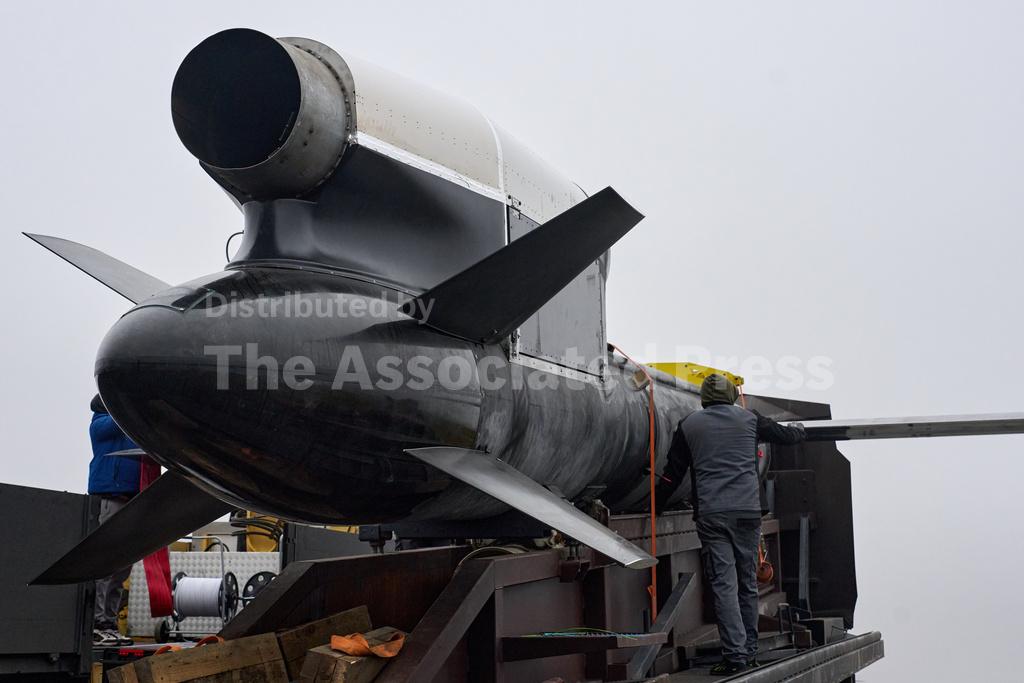
Ukrainian defense company Fire Point announced it is nearing completion of a domestically developed jet engine for its flagship F-5 Flamingo cruise missile.
Chief Designer and Co-Founder Denys Shtilerman said the new powerplant will replace previously used aviation engines and help expand manufacturing capacity.
“The most important thing is that it is designed specifically for low-altitude flight,” Militarnyi quoted him as saying.
“All the engines we use now were previously used in civil aviation. Their peak efficiency is roughly between 6,000 and 10,000 meters (19,685 to 32,808 feet), so they are not very effective at sea level.”
Fire Point initially equipped the missile with Ukrainian-made Ivchenko AI-25 or AI-25TL engines, which are more efficient than the single-flow engines commonly used in cruise missiles.
The company discreetly sourced used units of those systems through intermediaries to sustain early production, enabling it to build about three missiles per day.
Production Boost
Fire Point specified that it is now finalizing the new, low-bypass turbojet engine and expects production to increase once it enters service.
The company added that it had also localized most of the engine’s assembly, supporting the defense industrial base of Ukraine.
“When we switch to our own engine, we will produce as many missiles as are ordered,” Shtilerman said.
The F-5 Flamingo
Fire Point’s F-5 is a ground-launched capability measuring 14 meters (46 feet) long, has a weight of 6,000 kilograms (13,228 pounds), and a wingspan of 6 meters (20 feet).
It uses a 1,150-kilogram (2,535-pound) warhead and is equipped with an inertial navigation system as well as GPS and satellite components for flight and firing accuracy.
With its original Ivchenko propulsion, the missile can achieve a maximum speed of 950 kilometers (590 miles) per hour, an altitude of 5,000 meters (16,404 feet), and a range of 3,000 kilometers (1,864 miles).
The weapon was named “Flamingo” after a manufacturing error in early versions caused its exterior to turn pink.