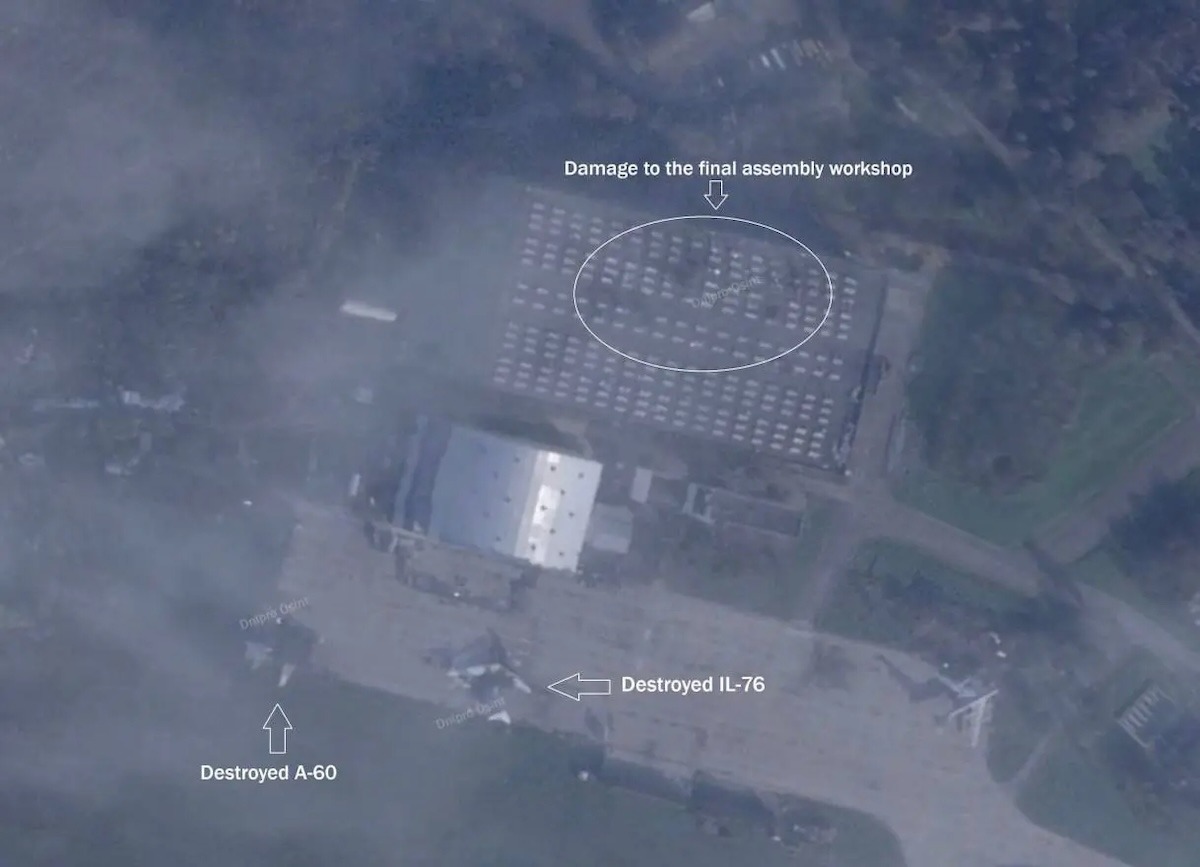
Ukraine appears to have carried out one of its most consequential deep strikes of the war, likely destroying Russia’s rare A-60 airborne laser aircraft and another high-value radar testbed.
Footage, eyewitness accounts, and satellite imagery reviewed by analysts — and circulated by the OSINT community Exilenova+ — showed a massive fire inside the Beriev plant (the A-60 manufacturer) in Taganrog, located in Russia’s southwest.
The blaze reportedly engulfed the A-60 prototype and a second airframe believed to be an A-100LL test aircraft, a critical platform supporting Moscow’s next-generation A-100 Airborne Warning and Control System (AWACS) program.
The A-60 and Taganrog
Analysts noted that the airframe seen burning in the footage matched the A-60’s distinctive tail-section hump.
Developed in the Soviet era on an Il-76MD airframe, the A-60 was an experimental laser-equipped aircraft reportedly built in only two prototypes for research into countering missiles and satellites.
While details about the program are scarce, the aircraft had an estimated cost ranging from about $150 to $480 million, according to Kyiv Independent.
Meanwhile, the facility in Taganrog is Russia’s primary center for developing, upgrading, and maintaining its A-50 and A-100 radar aircraft, as well as modernizing Tu-95MS strategic bombers.
Ukrainian Deep Strike
Ukrainian forces reported that a combination of Bars jet-powered one-way attack drones and Neptune cruise missiles was used in the operation, while Russian channels described extensive drone activity over the region.
Russian officials acknowledged the attack, reporting casualties and damaged buildings in Rostov, though they did not address the reports of affected military assets.
This development, following claims that Ukrainian forces damaged an estimated $7 billion worth of Russian aircraft at Belaya Air Base during “Operation Spider Web” in June, marks another setback for Moscow at a time when its defense industry is constrained by sanctions and limited funding.