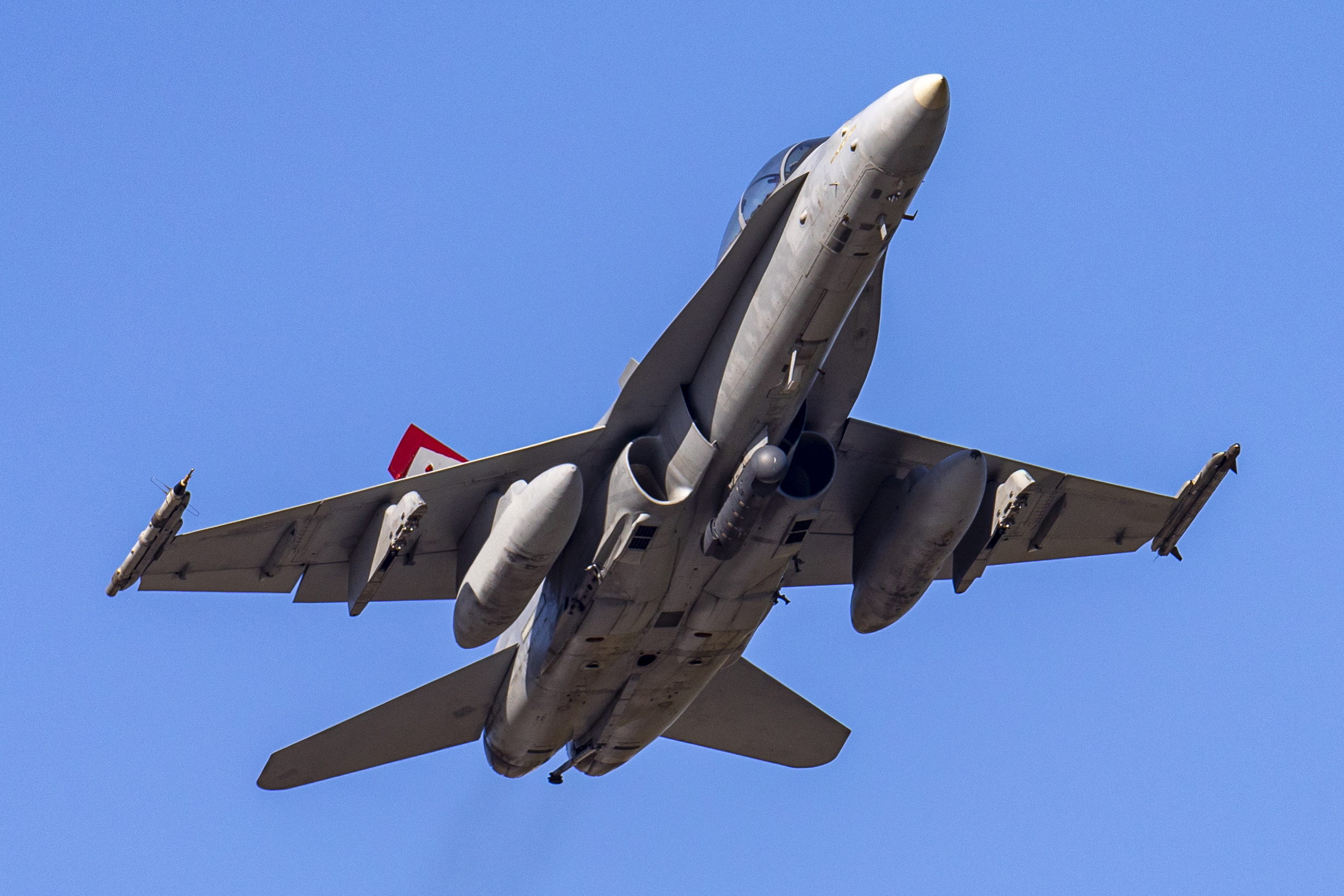
The US Marine Corps has approved the deployment of the Automatic Terrain Awareness and Warning System (ATAWS) across its F/A-18 Hornet fleet, with rollout scheduled to begin in early 2026.
The system builds on the Hornet’s existing Terrain Awareness and Warning System, which provides pilots with timely auditory and visual warnings of potential collisions with the ground or obstacles.
ATAWS advances this capability by not only warning pilots of an imminent crash, but if they fail to respond, automatically assuming control to recover the aircraft to a safe altitude.
Since legacy Hornets rely on manual throttles, ATAWS intervenes solely through flight-control inputs and activates only after a pilot fails to respond to all visual and auditory warnings, enabling automatic recovery when human reaction time is no longer sufficient.
“Any time a system is designed to intentionally take control of the aircraft away from the pilot, extreme diligence is required,” commanding officer of Air Test and Evaluation Squadron (VX) 31, Lt. Col. Timothy Burchett, said.
“We had to be absolutely certain it would not interfere with a mission or take action when it shouldn’t.”
To Reduce Future Losses
The requirement for such a system became increasingly clear after the service lost multiple aircraft and pilots in training and operational mishaps between 2010 and 2016.
Controlled Flight Into Terrain (CFIT) remains one of tactical aviation’s deadliest hazards, occurring when a fully functional aircraft is unintentionally flown into the ground.
In 2022, the US Air Force reportedly stated that CFIT incidents made up 26 percent of all aircraft losses.
Causes vary, but two of the most prominent are spatial disorientation and G-induced loss of consciousness (G-LOC).
Spatial disorientation is the loss of awareness of one’s position and motion relative to the environment. G-LOC, by contrast, results from high-G forces that reduce blood flow to the brain, causing unconsciousness.
Officials expect the system to reduce future losses of pilots and aircraft, boosting overall readiness and enhancing combat availability.
For both test pilots and operational units, ATAWS improves readiness and safety while preserving existing tactics and pilot habit patterns.
“ATAWS directly advances warfighter capability by ensuring assets are available for forward-deployed power projection,” Burchett explained.
“Every time an aircraft is lost to a mishap, it directly degrades the ability of the Marine Corps to forward project power.”
Testing, Approval
The approval follows a successful test campaign carried out between 2023 and 2025, during which ATAWS proved highly effective and reliable.
Air Test and Evaluation Squadrons VX-31 and VX-23 conducted the effort in three phases.
VX-23 completed 32 flights evaluating system logic and responses to various dive and recovery profiles, while VX-31 flew 16 missions focused on nuisance testing over flat desert and mountainous terrain to ensure the system would not trigger false warnings or automatic recoveries.
The final phase brought both squadrons together at China Lake for 16 full-performance flights executed over seven consecutive weeks.
These flights incorporated demanding high-G maneuvering and low-angle strafing runs, while flight-test engineers monitored real-time telemetry from the test bay.
“The team executed 177 test points that challenged and stressed the system,” VX-31 flight test engineer David Pineda said.
“Those test points validated that ATAWS met or exceeded the modeled performance.”
Sets Stage for Super Hornet, Growler
ATAWS has paved the way for integrating Automatic Ground Collision Avoidance System capability into the F/A-18E/F Super Hornet and EA-18G Growler.
VX-31 and VX-23 will apply lessons from the legacy Hornet program to these platforms, incorporating improvements and leveraging additional features such as potential automated throttle response not possible on older aircraft.
“The results of the test were incredibly successful, which is an absolute testament to the whole team of designers, engineers, and test pilots who diligently worked the program for many years,” Burchett said.
“ATAWS will save lives. There’s no higher return on investment than that.”