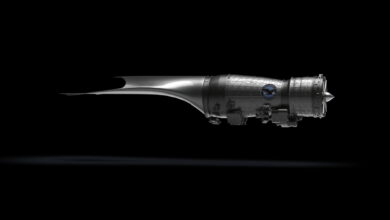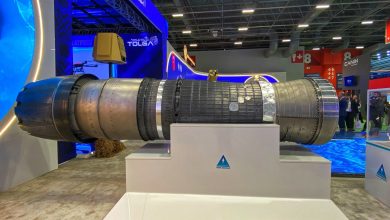
Northrop Grumman has partnered with Luminary Cloud to leverage artificial intelligence (AI) tools for the design of spacecraft propulsion components.
By merging Northrop Grumman’s propulsion expertise with Luminary Cloud’s AI platform and support from NVIDIA’s Computer-Aided Engineering team, the partnership aims to speed up development, cut costs, and drive innovation.
The project uses a “physics AI” model rather than conventional generative AI to simulate how physical systems behave and optimize the geometry of a spacecraft thruster nozzle.
“Physics AI is the next level of complexity in AI and Northrop Grumman is bringing this technology to our design engineers to dramatically speed up hardware development,” said Han Park, VP of AI integration at Northrop Grumman Space Systems.
“Using AI to make something small, like a spacecraft thruster, puts us on a path to do much bigger things, like using AI to design larger components or even an entire spacecraft.”
Physics AI
Generative AI can produce sophisticated outputs, text, visuals, or abstract concepts, but lacks an understanding of real-world forces and spatial dynamics.
Physical AI integrates these principles, enabling systems to navigate and respond accurately within complex three-dimensional environments.
Training physical AI requires large amounts of precise data on how objects interact under real-world conditions.
Simulations enable the efficient generation of synthetic data, which can be supplemented with sensor measurements using 3D reconstruction techniques.
The virtual environment positions robots and sensors to mimic operational behavior, enabling simulations that capture realistic physical interactions.
These simulations monitor rigid-body dynamics, contact events, and electromagnetic propagation within the operational space.