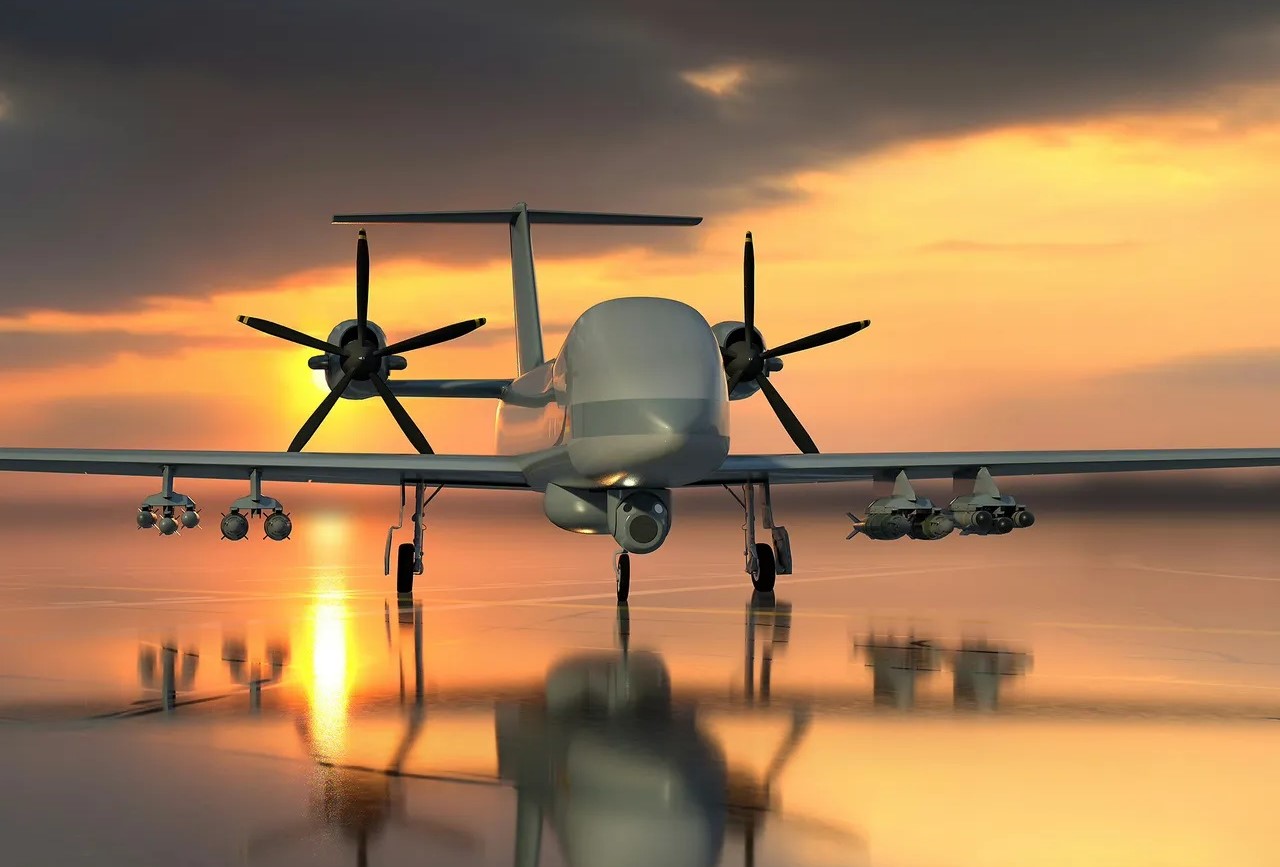
The Eurodrone program has completed its critical design review, confirming the structural, electronic, and functional maturity of Europe’s future medium-altitude, long-endurance (MALE) remotely piloted aircraft system.
With the design phase completed, the program now advances to prototype production and ground testing ahead of the drone’s maiden flight.
The first fully European MALE drone is being developed and produced by Airbus Defence and Space in cooperation with Leonardo and Dassault Aviation under a joint program involving Germany, France, Italy, and Spain.
The platform’s open architecture incorporates advanced technologies designed to ensure secure data exchange and interoperability with other mission systems.
Featuring advanced sensor suites, the aircraft is designed to deliver a payload capacity of 2.3 tonnes (5,070 pounds) and an endurance of approximately 40 hours.
Furthermore, the system is designed to comply with the highest airworthiness and safety standards, enabling its operation within civilian airspace.
“Combining advanced avionics, resilient navigation, and open architecture, Eurodrone sets a new benchmark in performance, interoperability, and growth potential,” the Organisation for Joint Armament Cooperation stated.
France’s Withdrawal
The milestone follows reports that France has decided to withdraw from the Eurodrone program, citing persistent concerns over costs, delays, and operational suitability.
A founding member of the initiative, France reportedly assessed the aircraft to be nearly twice as heavy as the US MQ-9 Reaper, a factor impacting both its performance and cost-efficiency.
The program itself is running roughly four years behind schedule, with entry into service now expected no earlier than 2030.
France now plans to redirect its financial and industrial resources toward higher-priority defense projects, including the sixth-generation Future Combat Air System program.
In parallel, the country aims to develop more agile and affordable remotely piloted aircraft systems to fill capability gaps in unmanned surveillance and light-attack operations.
To that end, the French defense procurement agency has contracted five domestic companies to develop demonstrators for the new capability.
Informed by lessons from the war in Ukraine, these platforms are expected to be low-cost, capable of long-endurance missions at medium altitude, able to perform multiple roles, and resilient against electronic jamming.