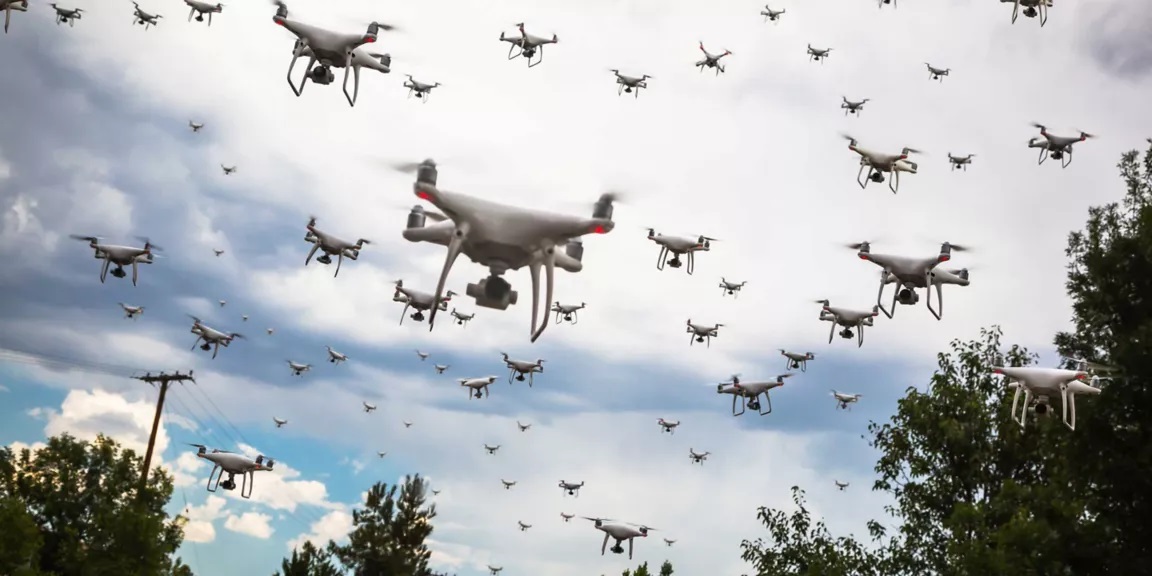
Honeywell has demonstrated its Stationary and Mobile UAS Reveal and Intercept system for US military operators, showcasing its counter-swarm drone capabilities.
The system was tested from both a ground vehicle and an aerostat positioned at an altitude of over 304 meters (1,000 feet).
Testing included integration with new detectors and effectors to meet operational needs.
“Swarm drones pose increasing risks to high-value assets – as a result, the ability to detect, track and counter them is a crucial part of modern military operations,” said Matt Milas, president of Defense and Space at Honeywell Aerospace Technologies.
“Our recent successful demonstrations not only provided strong examples of how Honeywell’s Stationary and Mobile UAS Reveal and Intercept system can provide critical capabilities on the battlefield, but they also proved the technology is highly reliable, scalable and ready to integrate into existing defensive systems.”
Features
Unveiled last year, the system combines beyond-visual-line-of-sight communication with command-and-control functions to detect, track, and counter drone swarms.
It can be deployed on vehicles or fixed platforms to protect critical assets.
It supports the integration of hardware from Blue Halo, Leonardo DRS, Pierce Aerospace, and Silent Sentinel.
Honeywell’s technology also features technologies from Walaris, Rocky Research, and Versatol.
Components include radio-frequency and optical sensors.
Latest Initiatives
The US-based firm continues to showcase new technologies while expanding its portfolio of defense projects through recent initiatives.
In June, Honeywell was selected to support the development of the US Navy’s Next-Generation Jammer Low Band system for the EA-18G Growler electronic attack aircraft.
The same month, the company proposed its F124 turbofan engine for future programs of the Japan Air Self-Defense Force.
The engine is being considered for replacement of the current T-4 trainer aircraft and for the future Collaborative Combat Aircraft program.