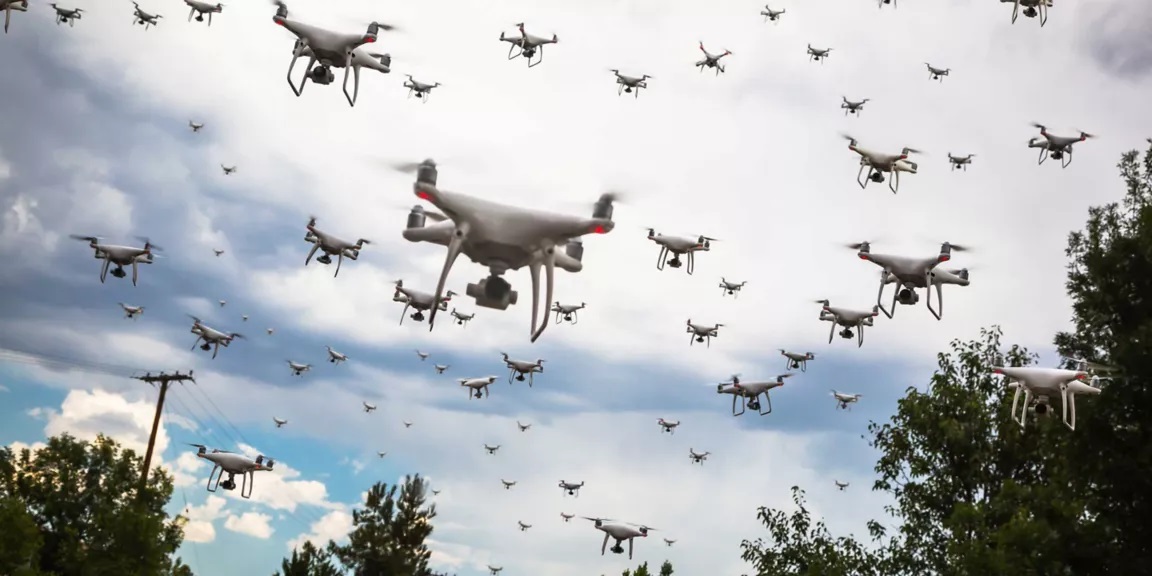
USAF Explores Atomic Clock Precision to Coordinate GPS-Denied Drone Swarms

The US Air Force Research Laboratory (AFRL) has requested proposals for a high-precision atomic clock technology to enhance the coordination and navigation of swarms of small drones operating in GPS-denied or degraded environments.
The proposals are being requested to gauge industry interest in an advanced position, navigation, and timing (PNT) technology capable of providing high timing coherency across a drone swarm, even without satellite navigation.
The Joint Multi-INT Precision Reference VPX ruggedized system incorporates the Next Generation Atomic Clock, enabling a single-digit picosecond (one trillionth of a second) stability and sub-nanosecond (one billionth of a second) accuracy.
Drone Swarms in GPS-Denied Skies
An atomic clock-based PNT system will allow drones to maintain a very accurate internal time reference, enabling synchronized movements, formation flying, sensor fusion, and coordinated missions without GPS.
Evolving enemy electronic warfare capabilities have made reliance on satellite-based communications a vulnerability for drone operations, as demonstrated in Ukraine.
Both Russia and Ukraine have deployed extensive electronic warfare systems that disrupt each other’s precision targeting and navigation through jamming and spoofing.
“The ability to achieve extremely high timing coherency between UAS (unmanned aerial system) in the swarm is critical,” an AFRL notice stated.
“This enables coordination, communication, and collective maneuvering in contested environments.”
Expected Features
The AFRL plans a decentralized PNT architecture that allows drones to navigate using onboard sensors and the relative positions of nearby aircraft.
“This PNT testbed will allow the platform the ability to instantiate local reference frames using relational measurements between platforms without GPS by employing a decentralized open PNT architecture to enable cold-start, progressively enhanced PNT for a swarm of platforms,” the notice added.
The initial capability requirement is to support a swarm of four drones, with the potential for scalability to larger swarms in the future.
Resilience against electronic warfare, especially GPS jamming and spoofing, is another key requirement.
Moreover, strict size, weight, and power compliance is required to fit compact, efficient systems onto small drones without degrading performance.
The deadline for submissions is September 19, 2025.