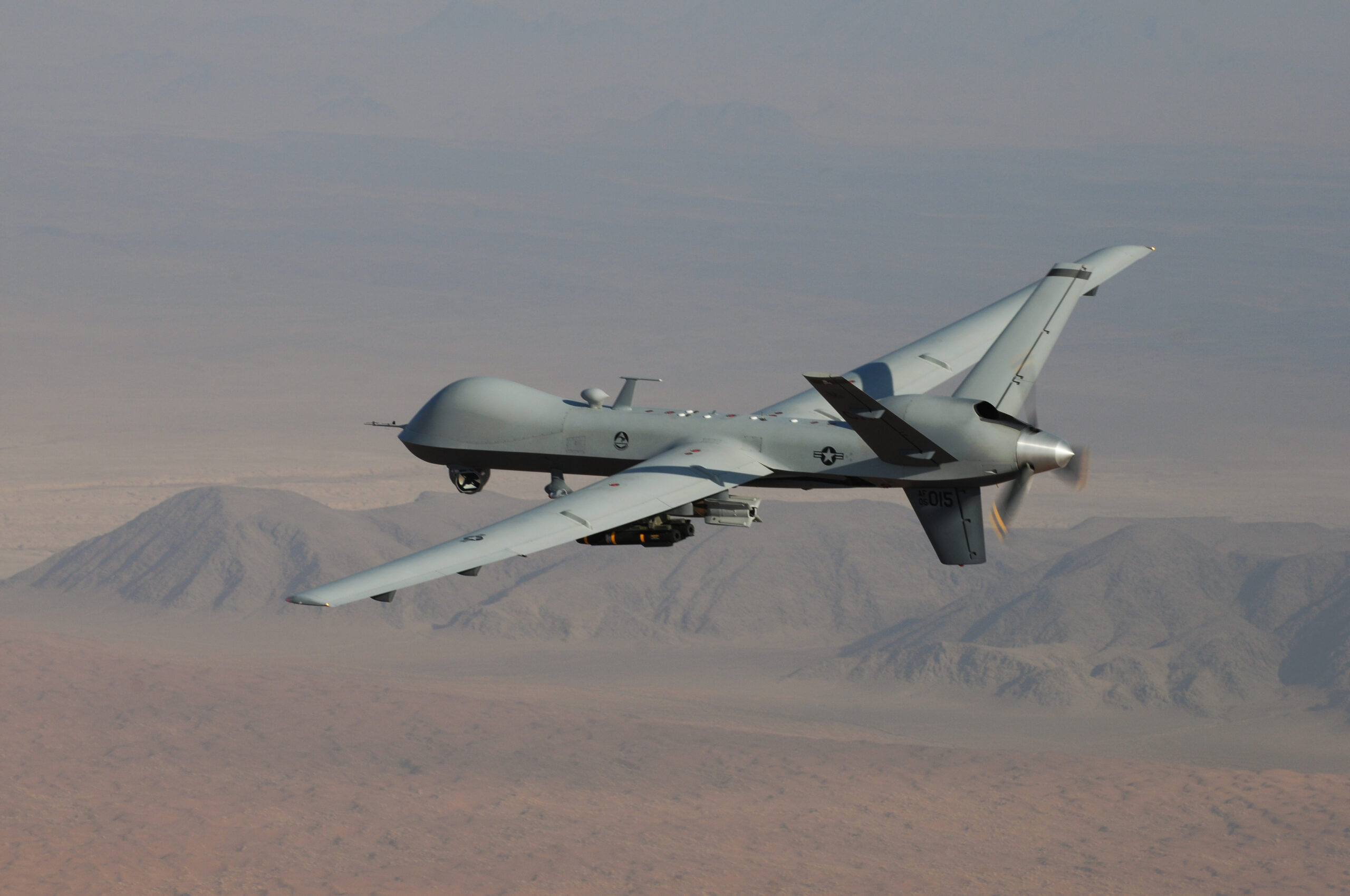
The US Air Force is planning to deploy MQ-9 Reaper drones to South Korea for a three-month rotation, marking its first extended presence on the Korean Peninsula.
Starting in September this year, an unspecified number of Reaper drones will operate out of the US Seventh Air Force base in Gunsan (Kunsan), located in the country’s west and facing the Yellow Sea, Chosun Daily reported.
Some defense experts interpret this move as Washington’s deterrence against China and North Korea.
“The MQ-9 has strike capabilities, but it is fundamentally a surveillance platform,” Asian Institute for Policy Studies Research Fellow Yang Uk shared with the South Korean outlet.
However, Seventh Air Force spokesperson Maj. Laura Hayden declined to confirm the report with Stars and Stripes, while stating, “Our focus remains on readiness while sustaining and strengthening our alliance with [South Korea].”
Meanwhile, South Korea’s Ministry of National Defense spokesperson Jeon Ha Gyu said that Seoul cannot confirm the plan as the Reapers are US military assets.
Reaper in South Korea
General Atomics developed the MQ-9 Reaper as primarily an intelligence collection asset that supports strike, coordination, and reconnaissance missions.
It is armed with AGM-114 Hellfire missiles, GBU-12 Paveway II, GBU-38 Joint Direct Attack Munitions (JDAMs), GBU-49 Enhanced Paveway II, and GBU-54 Laser JDAMs.
With an endurance of over 27 hours, reaching altitudes of up to 50,000 feet (15,240 meters), and a range of approximately 1,150 miles (1,850 kilometers), it can reportedly reach Chinese cities such as Beijing, Shanghai, Hangzhou, and Qingdao when launched from Gunsan Air Base.
The Reaper has been to South Korea in the past for training exercises.
In its first live-fire test held on the Korean peninsula in April 2024, the drone successfully fired GBU-12 munitions against its targets.
It also participated in Exercise Freedom Flag 25-1 at Gunsan Air Base in May this year, where the US Air Force and Marine Corps maintainers shared techniques to enhance MQ-9 readiness in expeditionary environments.
Meanwhile, the upcoming deployment, if confirmed, will be the Reaper’s longest continuous period of operation on the Korean peninsula.
It will also happen around the same time that the US will conduct its final withdrawal of its A-10 Thunderbolt II fleet from the East Asian territory, which will be replaced by fourth- and fifth-generation fighter jets.